
Jul 19, 2026
The Science of Color and Sugar: Transforming Crops with 5-ALA
Have you ever wondered what triggers the spectacular shift in color when a grape deepens into a rich purple, or a pale rose bursts into crimson?
This transition—known as veraison—is the exact moment where yield transforms into profit. However, achieving uniform coloring and high sugar accumulation under fluctuating weather can be a major challenge. 5-ALA (5-Aminolevulinic Acid) is a natural signaling molecule that solves this bottleneck.
1. Sweetening & Coloring: The Master Switch for Premium Quality
During ripening, crops must break down green chlorophyll to reveal rich pigments (coloring) while rapidly mobilizing sugars into cells (sweetening).
The Coloring Mechanism: 5-ALA stimulates the upstream enzymes responsible for anthocyanin synthesis—the natural pigments that give grapes and roses their brilliant reds and purples.
The Sweetening Shift: It increases the "sink strength" of the fruit, meaning it actively pulls sugars from the leaves straight into the berries, leading to a rapid, uniform jump in Brix degrees (°Bx).
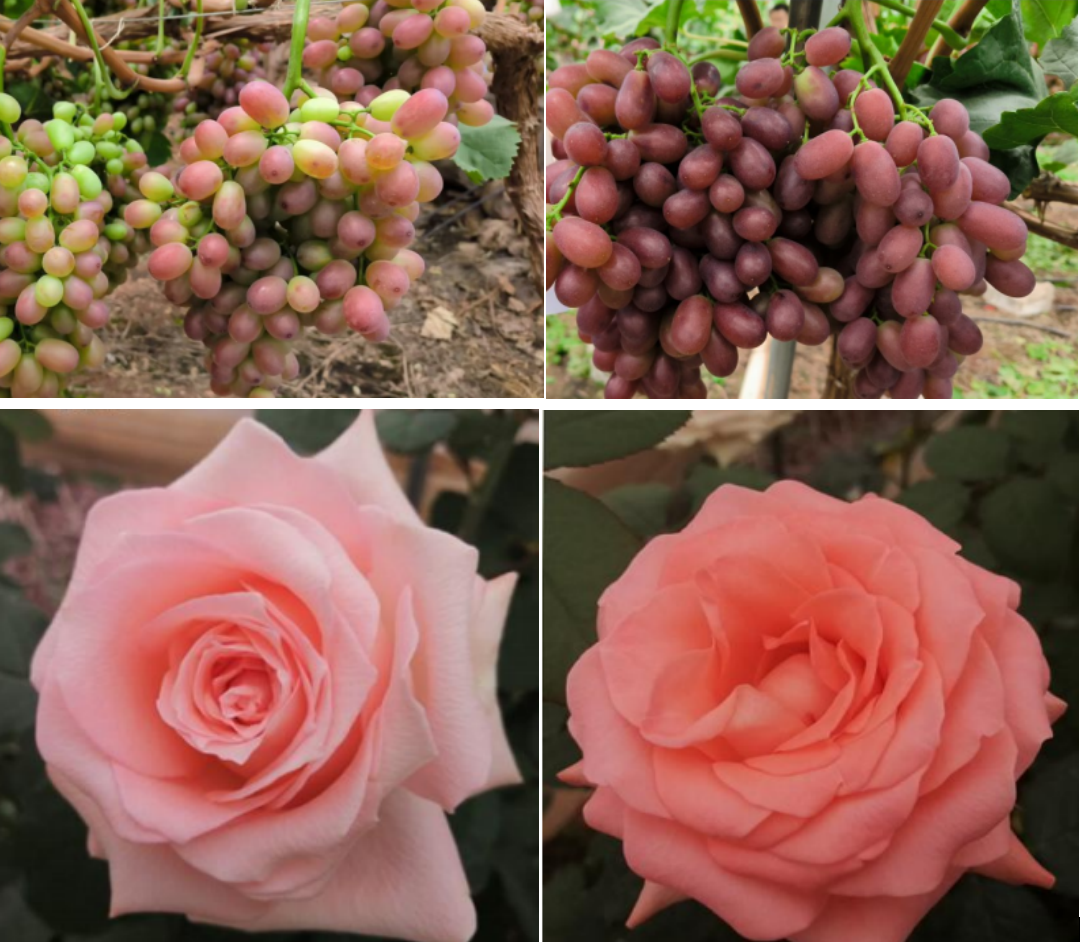
Visual Impact: Notice the shift from patchy green-red to a flawless, uniform deep purple in the grapes, and the intensely saturated, market-ready hue across the rose petals.
2. Low Dose, High Efficiency: Micro-Dosages, Macro Results
Unlike bulk biostimulants that require heavy applications, 5-ALA functions as a cellular trigger operating at extreme biological potency.
PPM-Level Precision: 5-ALA achieves definitive results at incredibly low field concentrations—typically just 10 to 30 mg/L (ppm).
Cost-Effective Logistics: Because it works at the micro-level, a tiny amount of a 10% soluble powder goes a long way. This minimizes storage overhead and reduces input costs while maximizing the economic return per hectare.
3. Improving Quality & Increasing Volume: The Ultimate Double Win
In traditional farming, pushing for higher yields (volume) often dilutes fruit quality (color and flavor). 5-ALA breaks this compromise by enhancing the plant's foundational photosynthetic efficiency.
Elevating Quality Traits: For grapes, it thickens the skin to reduce fruit splitting and strengthens pedicels to minimize pre-harvest drop. For roses, it reinforces cell walls to create sturdy blooms that resist shipping damage and last longer in a vase.
Securing Commercial Volume: By optimizing energy production, 5-ALA ensures that every single berry or bud expands to its full genetic potential, delivering a highly uniform harvest that easily meets strict export grading standards.
Quick Application Guide
Grapes: Foliar spray at 10–20 ppm at the start of veraison (5–10% berry color change). Repeat 7–10 days later for perfect uniformity.
Roses: Spray at the early budding stage to enrich petal pigmentation and guarantee deep color saturation.
Tank Mix Tip: Maintain a weakly acidic pH (3.0 – 5.5) in the spray tank to keep the 5-ALA molecule perfectly stable.
Partner With Us
Interested in the products mentioned in the post?
Contact our export team for product availability and partnership opportunities.