
Back to PGR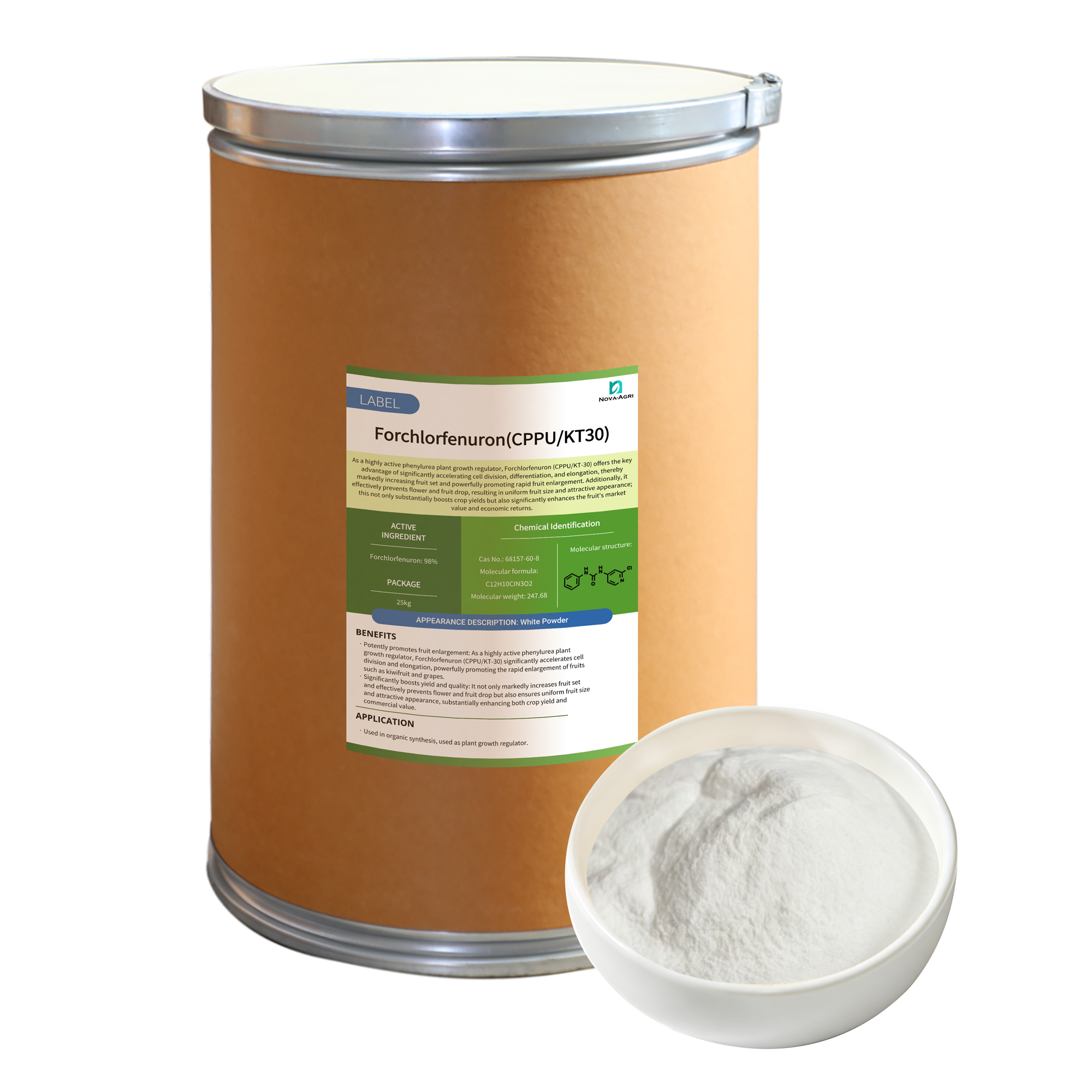
PGR
Forchlorfenuron
Also known as: CPPU, KT-30
As a highly active phenylurea plant growth regulator, Forchlorfenuron (CPPU/KT-30) offers the key advantage of significantly accelerating cell division, differentiation, and elongation, thereby markedly increasing fruit set and powerfully promoting rapid fruit enlargement. Additionally, it effectively prevents flower and fruit drop, resulting in uniform fruit size and attractive appearance; this not only substantially boosts crop yields but also significantly enhances the fruit's market value and economic returns.
Technical specifications
- Product Name
- Forchlorfenuron
- Other Names
- CPPU, KT-30
- Appearance
- White Powder
- Assay
- 98%
- CAS No.
- 68157-60-8
- Molecular formula
- C12H10CIN3O2
- Molecular weight
- 247.68
Package
25kg Drum
Key benefits
- Potently promotes fruit enlargement As a highly active phenylurea plant growth regulator, Forchlorfenuron (CPPU/KT-30) significantly accelerates cell division and elongation, powerfully promoting the rapid enlargement of fruits such as kiwifruit and grapes.
- Significantly boosts yield and quality It not only markedly increases fruit set and effectively prevents flower and fruit drop but also ensures uniform fruit size and attractive appearance, substantially enhancing both crop yield and commercial value.
Suggested dosage & application
- For Formulators & Manufacturers As a 98% Technical Grade concentration, this ultra-high activity product must be formulated before field use. Solubility: Insoluble in water. Highly soluble in organic solvents like ethanol or acetone; typically formulated into 0.1% or 1% SL (Soluble Concentrate) or soluble powders. Formulation Note: Extremely stable under normal heat, light, and storage conditions. Ensure proper wetting agents are used to prevent active ingredient precipitation upon field dilution. Synergistic Blends: Often co-formulated with Gibberellic Acid (GA3) to achieve a powerful dual effect: GA3 elongates cells while CPPU accelerates cell division, maximizing fruit size without deformation.
- Reference Field Application Rates Because Forchlorfenuron (CPPU) possesses extremely high biological potency, field application requires precise dosing, typically ranging from 5 to 20 mg/L (ppm). Exceeding these rates can cause fruit distortion or splitting. For Kiwifruit: Dip or spray young fruits at 5 to 20 mg/L exactly 20 to 25 days after full bloom to trigger intense cell division and dramatically increase final fruit weight. For Grapes: Spray or dip clusters at 5 to 10 mg/L approximately 10 to 15 days post-bloom (when berries are matchhead to pea-sized) to increase berry size and reduce pre-harvest drop. For Melons & Cucumbers: Spray the flower ovaries or dip the flower pedicels at 10 to 20 mg/L on the day of blooming or 1 day prior to secure fruit set and accelerate early melon expansion. To Ensure Optimal Efficiency: Application must be highly uniform. Direct contact with the fruit is essential, as CPPU exhibits very low systemic mobility within the plant tissue.
Partner With Us
Need samples, COA, or formulation support?
Contact our export team for pricing, regulatory documentation, and tailored supply planning for Forchlorfenuron.
Start an inquiry